
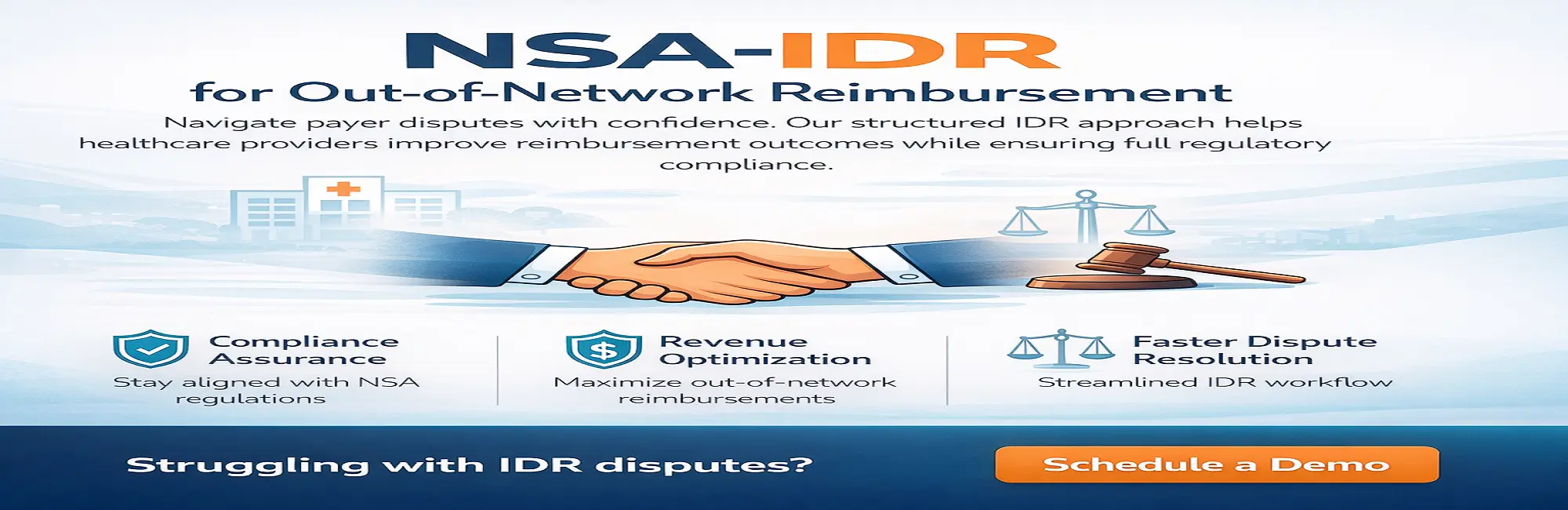
A complete Guide for IDR NSA to help
Providers to Maximize Out-of-Network
Reimbursement
Introduction
The implementation of the No Surprises Act has significantly reshaped the U.S. healthcare reimbursement landscape. Designed to protect patients from unexpected medical bills, this legislation also introduced new challenges—and opportunities—for healthcare providers, especially regarding out-of-network billing and reimbursement disputes.
One of the most critical components of the Act is the Federal Independent Dispute Resolution (IDR) Process, which allows providers to dispute underpaid claims from insurance companies.
In this comprehensive guide, we will break down everything healthcare providers, billing companies, and RCM professionals need to know about the NSA IDR process, including timelines, eligibility, documentation, and strategies to maximize reimbursement.
What is the No Surprises Act (NSA)?
The No Surprises Act, effective January 1, 2022, protects patients from surprise medical bills in situations such as:
-
- Emergency services
- Out-of-network care at in-network facilities
- Air ambulance services
While the Act limits patient liability, it shifts the payment negotiation burden to providers and payers, making the IDR process essential for revenue recovery.
What is the Federal IDR Process?
The Independent Dispute Resolution (IDR) process is a federal arbitration system that resolves payment disputes between healthcare providers and insurance companies.
It is commonly referred to as:
-
- NSA IDR process
- Federal arbitration for medical billing
- Out-of-network dispute resolution
Through this process, both parties submit their proposed payment amounts, and a certified arbitrator selects one.
Why the IDR Process is Important for Healthcare Providers
The IDR process is not just a compliance requirement—it’s a revenue recovery opportunity.
Key Benefits:
-
 Recover underpaid claims
 Increase revenue per case
 Ensure fair reimbursement
 Strengthen payer negotiation strategy
Many providers fail to utilize IDR due to complexity, resulting in significant revenue leakage.
Step-by-Step Federal NSA IDR Process
1. Initial Payment or Denial
After a claim is submitted, the payer issues:
-
- Initial payment
- Denial notice
2. Open Negotiation Period (30 Days)
Providers must initiate a 30-day open negotiation period with the payer.
 Key Tip:
Submit a strong negotiation request with proper documentation to improve outcomes
3. IDR Filing (Within 4 Days)
If negotiation fails, providers have 4 business days to initiate IDR.
Failure to meet this deadline results in loss of dispute rights.
4. Arbitrator Selection
Both parties select a certified IDR entity to review the case.
5. Submission of Offers
Each party submits:
-
- Payment amount
- Supporting documentation
6. Final Decision
The arbitrator selects one of the two offers (baseball-style arbitration).
Key Documentation Required for IDR
To win IDR disputes, documentation is critical:
-
- CPT/HCPCS codes
- Medical necessity records
- Provider qualifications
- Market rate comparisons
- Previous payer reimbursement data
Common Mistakes in NSA IDR Process
Avoid these costly errors:
 Missing deadlines Incorrect coding Weak documentation Filing ineligible claims Ignoring batching opportunities
Eligibility Criteria for IDR
Not all claims qualify for IDR. Eligible cases include:
-
- Out-of-network emergency services
- Non-emergency services at in-network facilities
- Air ambulance services
Batching in IDR: Increase Efficiency
Providers can batch similar claims to:
-
- Reduce administrative cost
- Improve efficiency
- Strengthen negotiation power
How Much Can Providers Recover Through IDR?
Based on industry trends:
-
- Providers recover 30%–80% more than initial payer offers
- High-value specialties see even higher returns
Challenges in Managing IDR In-House
Many providers struggle due to:
-
- Complex regulations
- Tight deadlines
- Resource limitations
- Lack of expertise
How RCM Companies Help with NSA IDR
Professional RCM services can:
-
- Identify eligible claims
- Handle negotiation & arbitration
- Ensure compliance
- Maximize reimbursement
Best Practices for IDR Success
 Maintain accurate documentation Track timelines strictly Use data-driven negotiation Leverage experienced RCM partners Focus on high-value claims
Conclusion
The Federal NSA IDR process is no longer optional—it is a critical revenue recovery tool for healthcare providers operating in the U.S.
With the right strategy, documentation, and expertise, providers can significantly improve reimbursement outcomes while staying compliant with federal regulations.
Need Help with NSA IDR Process?
At InfinaRCM, we specialize in:
-
- End-to-end IDR management
- Out-of-network billing optimization
- Healthcare RCM solutions
 Contact us today to unlock hidden revenue in your denied and underpaid claims. Follow us on LinkedIn