
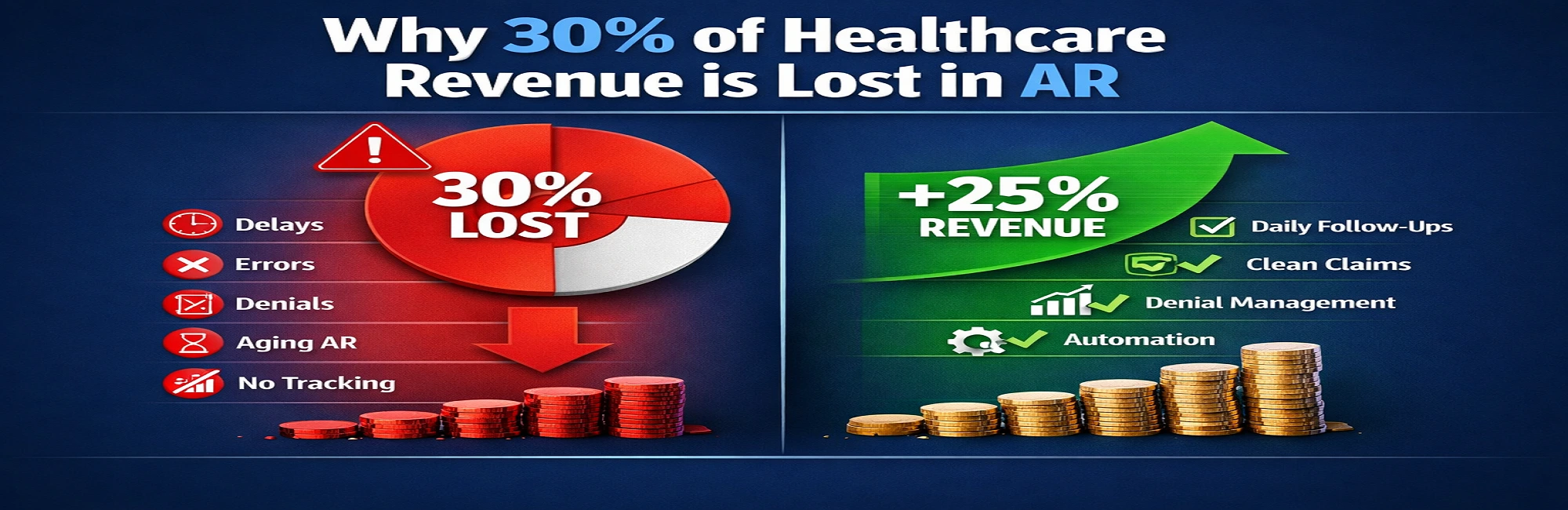
 Why 30% of Healthcare Revenue is
Lost in AR
Introduction: The Hidden Revenue Crisis in
Healthcare
Healthcare providers often focus on patient volume, billing accuracy, and front-desk efficiency to grow revenue. But the biggest financial leakage doesn’t happen upfront—it happens after the claim is submitted, inside Accounts Receivable (AR).
Industry data and operational audits reveal a critical truth: Up to 30% of healthcare revenue is lost due to poor AR management.
This isn’t just a billing issue. It’s a systemic revenue cycle failure that directly impacts cash flow, profitability, and long-term sustainability.
What is Accounts Receivable (AR) in
Healthcare?
Accounts Receivable (AR) refers to the outstanding payments owed to healthcare providers by insurance companies and patients for services already delivered.
A healthy AR process ensures:
- Faster reimbursements
- Lower denial rates
- Improved cash flow
- Financial stability
But when AR is mismanaged, revenue gets delayed, denied, or permanently lost.
The 5 Major Reasons Why Healthcare
Revenue is Lost in AR
1. Delayed Follow-Ups on Claims
One of the most common causes of revenue loss is inconsistent or delayed follow-ups.
- Claims remain unpaid for weeks or months
- Insurance companies deprioritize old claims
- Collection probability drops significantly after 30–60 days
 Impact: The longer a claim sits, the lower the chances of recovery.
2. High Rate of Claim Errors and Rejections
Even minor errors in claims can lead to:
- Immediate rejections
- Payment delays
- Resubmission cycles
Common issues include:
- Incorrect patient information
- Coding errors
- Missing modifiers
Impact: Poor clean claim rate leads to operational inefficiency and revenue delays.
3. Ineffective Denial Management
Denials are inevitable—but unmanaged denials are costly.
Many practices fail to:
- Track denial trends
- Identify root causes
- Implement corrective actions
Impact: The same denials repeat, leading to consistent revenue leakage.
4. Aging Accounts Receivable (90+ Days)
AR aging is one of the strongest indicators of revenue health.
- Claims older than 90 days are significantly harder to collect
- Recovery rates drop sharply over time
Impact: A large portion of revenue becomes unrecoverable.
5. Lack of Visibility and Performance Tracking
Without proper reporting and dashboards:
- No insight into AR performance
- No accountability
- No optimization strategy
Impact: Practices operate blindly, allowing inefficiencies to persist.
The Real Cost of Poor AR Management
When these issues combine, the result is:
 Lost revenue (up to 30%)
 Slower cash flow
- Reduced profitability
 Limited growth potential
In many cases, practices try to compensate by increasing patient volume—when the real solution lies in fixing AR processes.
How to Fix AR and Recover Lost Revenue
High-performing healthcare organizations follow a structured AR strategy:
 1. Daily AR Follow-Ups
Ensure every unpaid claim is actively tracked and followed up.
2. Maintain a Clean Claim Rate Above 98%
Reduce rework and accelerate reimbursements.
3. Implement Strong Denial Management
- Track denial reasons
- Fix root causes
- Prevent repeat errors
4. Control AR Aging Aggressively
Prioritize claims based on aging to maximize recovery.
5. Use Data-Driven Dashboards
Monitor:
- AR days
- Denial rates
- Collection performance
The Revenue Opportunity: Increase Revenue
Without More Patients
Here’s the most important insight:
Fixing AR can increase revenue by 15–25%—without adding a single new patient.
That means:
- Higher efficiency
- Better margins
- Stronger financial health
Why Outsourcing AR Management is a Smart
Move
Many healthcare providers are now partnering with Revenue Cycle Management (RCM) experts to:
- Improve AR recovery rates
- Reduce administrative burden
- Implement advanced workflows and automation
- Ensure compliance and accuracy
Conclusion: Stop the Revenue Leakage Today
If your AR is not actively managed, you are not just delaying payments—you are losing revenue permanently.
The difference between average and high-performing practices lies in one key area: How effectively they manage Accounts Receivable.
 Free AR Audit – Identify Your Revenue
Leakage
Want to know how much revenue your practice is losing?
We offer a FREE AR Audit to identify:
- Uncollected revenue
- Denial trends
- Process gaps
 Contact us today or request your free audit to recover your lost revenue.